Lone star souvenirs
Lone Star issued a handful of models aimed primarily at the London tourist trade. These appeared under the ‘Souvenirs’ heading in its trade catalogues.
New Routemaster
The first ‘Souvenir’ model was the iconic Routemaster bus which, at the time, was a familiar sight on The Capital’s streets. Nearly all British toy manufacturers added a Routemaster bus to their ranges, but Lone Star’s versatility meant it could supply this and its other Souvenir models separately direct to London based ‘giftware’ wholesalers and souvenir stores and was not limited to the traditional ‘toy shop’ route to market.
Rivals ‘Modern Products’ with its ‘Budgie Toys’ range was already doing something similar after partnering up with London souvenir wholesalers H. Seener Ltd. Seener marketed several ‘Budgie Toys’ models as London souvenirs including a Routemaster and FX4 taxi.
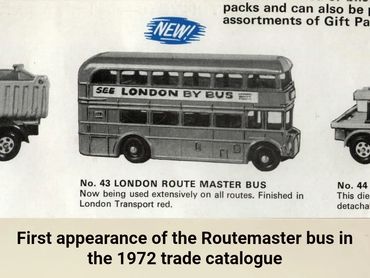
Lone Star’s Routemaster first appeared in the 1972 trade catalogue where it was shown as No.43 in the new Commercials range. Presumably the new model wasn’t yet ready as the photo actually depicts Lone Star’s existing and much smaller Tuf-Tots Routemaster bus.
The new Routemaster never joined the Commercial range, its proposed model number of 43 being later allocated to the ‘Water Pipe Truck’. Instead, Lone Star recognised the full potential of the model and marketed it as a stand-alone item. It therefore appeared under the ‘Speciality Lines’ heading in future trade catalogues until other models introduced to become the ‘Souvenir’ range.
Both of Lone Star’s different scale Routemasters were cast in two halves but unusually this was vertically down the centre of the bus. This was rather clever as on the new larger model it enabled Lone Star to include the seats and rear staircase in the 2 half castings.
Royal Routemasters
Lone Star took full advantage of the Souvenir trade by issuing two special variations of its popular Routemaster bus. The first arrived in 1977 sporting Lone Star’s famous ‘gleam finish’ which was more commonly found on its toy guns. This special model was issued to celebrate the ‘1977 Silver Jubilee’. Twenty-Five real Routemasters were repainted silver to mark the occasion and Dinky, Matchbox & Corgi Toys all issued their own silver painted ‘Silver Jubilee’ buses. Lone Star issued its version on ‘Commercials’ branded card packaging. Presumably this was to better show off this special edition as the standard Routemaster packaging was an enclosed card box with artwork depicting the bus in red.
A second ‘Gleam finish’ Routemaster was issued in 1981 for the Royal Wedding but by now the packaging had changed to a window box meaning the model was clearly visible.
Fire Engine & Taxi
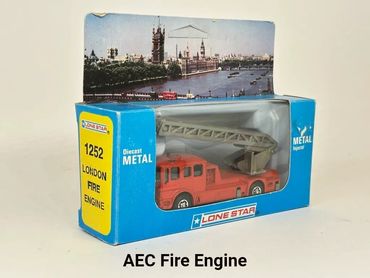
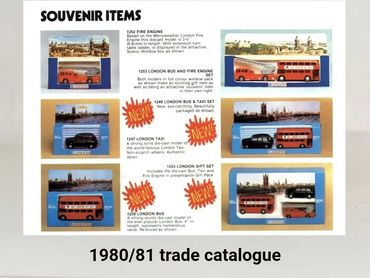
In the early 1980s the Routemaster was joined first by the existing AEC Fire Engine from the Impy/Commercial range and then by a new model of the London FX4 ‘Black Cab’. The 3 souvenir models were available individually in the new window boxes which featured a photo of the London skyline. New twin packs were introduced as well as a set which contained all 3 models. The sets including the Fire Engine are harder to find and appear to have been discontinued by the mid-1980s.
More Routemasters
A rare version of the Routemaster appeared in bright green. This received the standard ‘See London By Bus’ adverts and is not to be confused by later promotional models finished in a ‘sludge’ green colour. The gleam finish Routemasters also appeared with the standard ‘See London By Bus’ adverts as surplus stocks were used up.
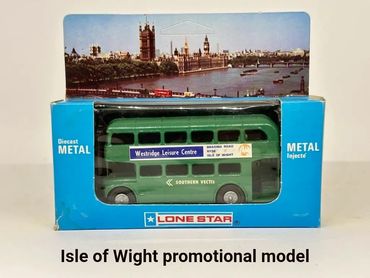
The ‘sludge’ green buses were produced for the Isle of Wight tourist trade with this shade of green meant to represent the livery used by the local bus operator ‘Southern Vectis’. Lone Star supplied these buses with ‘Newport’ destination stickers but apparently the various side adverts were applied locally by inmates at the islands prison. There must have been left over stocks of this model as several ‘Code 3’ versions are available adorned with various stickers and transfers.
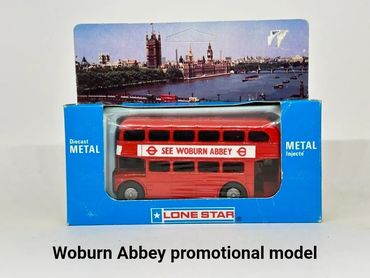
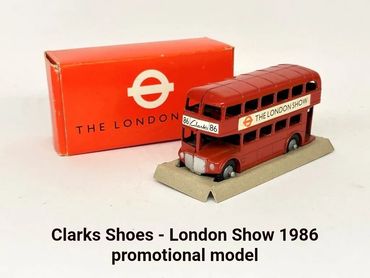
The standard red Routemaster was used for several promotional models with adverts including Woburn Abbey and Selfridges.
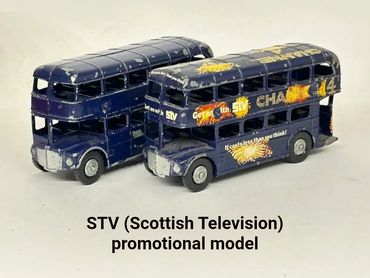
A much rarer promotional model was for Scottish Television with the Routemaster this time finished in dark blue.
In 1986/87 a model of the Coronation Coach was briefly added to the ‘Souvenir’ range packaged either on its own or together with 8 horses.


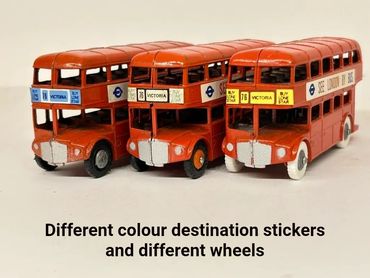
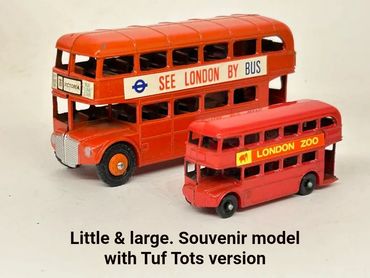


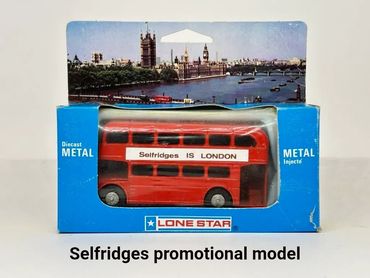
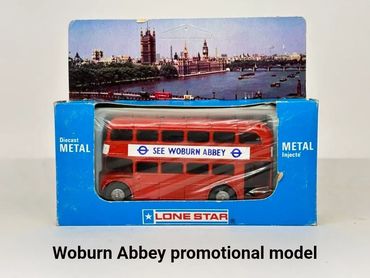



TRADE CATALOGUE ENTRIES

Wicke Era
The bus and taxi continued to be available under Wicke ownership from 1983 right up until the closure of Lone Star’s last UK factory in 1988. In these final years both models appeared in packaging with ‘British Made’ stickers added, a last ditched attempt to fight back against the onslaught of cheap China made toys flooding the UK.
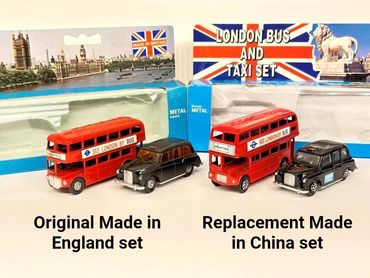
To survive Wicke had been forced to move production of Lone Star’s more popular ranges to China. However, rather than going to the expense of shipping the tooling for its Routemaster and Taxi to the Far East, Wicke instead sourced similar models from an existing Chinese manufacturer.
It’s interesting to note that at the time Lone Star introduced its Routemaster it was the low-cost, cheaper quality alternative to the mainstream manufacturer’s offerings. However, by the time production ended in 1988 it had become the better-quality more expensive alternative to the masses of cheaper Far East produced London buses which had now flooded the souvenir market. Indeed Lone Star’s London Bus was initially competing against Corgi and Budgie Toys Routemasters together with Matchbox’s ‘The Londoner’ Daimler Bus. By the end these models had disappeared but had been replaced by several unbranded Chinese copies of all these buses, plus several others.
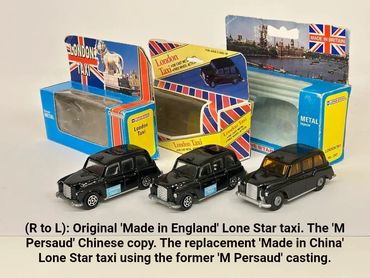
With this in mind its surprising that Lone Star’s Routemaster was never copied in the Far East, its taxi however was cloned and along with a copy of the Budgie Toys Routemaster was available in a set initially manufactured in Hong Kong and imported by M. Persaud Ltd.
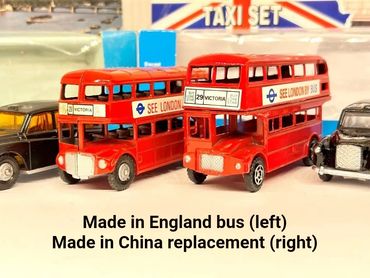
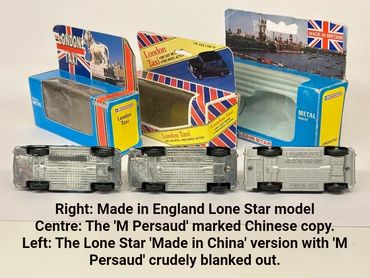
It’s therefore ironic that it was the ‘M Persaud’ bus and taxi which Wicke would source in China to replace Lone Star’s long service ‘Made In England’ models. It’s not clear whether M. Persaud were part of this deal or if Wicke went direct to the factory in China but either way a copy of Lone Star’s taxi, manufactured to compete again the Lone Star taxi, was now the new Lone Star taxi!
The M.Persaud name under both models was crudely blanked off as the bus and taxi now appeared in full Lone Star branded packaging with the Routemaster even featuring near identical stickers to the ‘Made in England’ original. Continuity was obviously a key consideration as Lone Star didn’t bother to update its trade catalogue images with the new China models.
With fierce competition these final Lone Star souvenir models sadly soon vanished last appearing in the 1990 trade catalogue.
Made In China Models (1988-1991)